Video
Video tapes and film (home movies) tend to collect dust and possibly moisture and will deteriorate over time, leaving treasured memories and footage left behind which could be lost forever.
The good news is that the content of all these items can be digitised thus preserving your treasured and possibly valuable memories and presenting them in a format that can be saved forever and easily shared with family and friends wherever they may be in the world.
Here’s an image guide to identifying several of the most popular consumer-based (as opposed to professional based) items you may have. For formats not pictured please contact us. I'm sure it will be a format we can digitise. Refer to our lists.
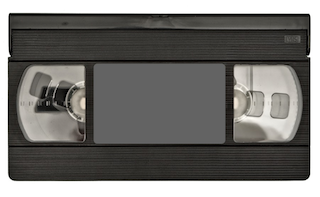
VHS Video Cassette Tape & S-VHS Video Cassette Tape:
The Video Home System (VHS) became the most widespread and common consumer-based video cassette tape format and is perhaps the most easily identifiable video cassette tape format.
Super VHS (S-VHS), while similar in appearance is one of the many different improvements to the VHS format. S-VHS simply offered improved picture quality over VHS tapes. One drawback was the requirement of an S-VHS VCR (Video Cassette Recorder) player needed to record and playback.
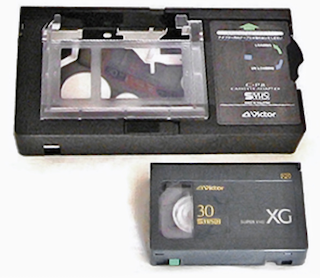
VHS-C Video Cassette Tape & S-VHS-C Video Cassette Tape:
VHS-C is the compact VHS video cassette format, introduced in 1982, and used primarily for consumer-grade compact analogue camcorders.
The format is based on the same video tape used in VHS video cassettes and can be played back in a standard VHS VCR player using a special adapter cassette. S-VHS-C (Super VHS-C) versions were also available.
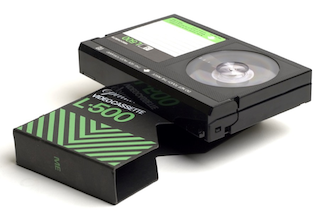
BETAMAX Video Cassette Tape:
Revolutionary for its day, the Betamax format was on its way to becoming the industry standard until the appearance of VHS a year later. Betamax was probably a bit sharper and crisper, but VHS offered longer-playing ability, which made it possible to record an entire movie on one three-hour tape.
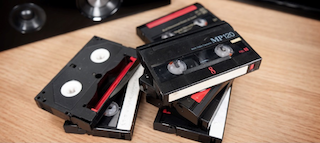
8mm (Video8, Hi8, Digital8) Video Cassette Tapes:
Video8, Hi8, and Digital8 are all 8mm video cassette tape formats that were the first to be small enough to easily fit into a consumer camcorder. Whilst similar in appearance they each presented an improvement in image quality with each iteration from Video8 to Hi8 to Digital8.
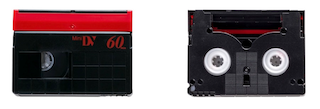
MiniDV Video Cassette Tape:
MiniDV video cassette tape remains the most modern type available in both sound and picture quality and being very small in size, ease of transport.
Converting Old Video Tapes to Digital
Apart from MiniDV whilst still in professional use, the remainder are now mostly obsolete. To add to their obsolescence most people have disposed of their VCRs and production of VCRs also ceased a few years ago making it impossible to see what very important treasured memories may be there.
Harnessing our years of experience even damaged video cassettes can be repaired and using the best available equipment and technical knowledge we can arrange for the digitised converted content to be presented to you on any of the following devices... DVD, USB, HDD (Hard Disc Drive) or SSD (Solid State Drive). The choice is yours. In these formats your treasured memories can be shared with family and friends here and around the world.