Audio
Audio tapes and records tend to collect dust and possibly moisture and will deteriorate over time, leaving treasured memories behind which could be lost forever.
The good news is that the content of all these items can be digitised thus preserving your treasured and possibly valuable memories and presenting them in a format that can be saved forever and easily shared with family and friends wherever they may be in the world.
Here’s an image guide to identifying several of the most popular consumer-based (as opposed to professional based) items you may have. For formats not pictured please contact us. I'm sure it will be a format we can digitise. Refer to our lists.
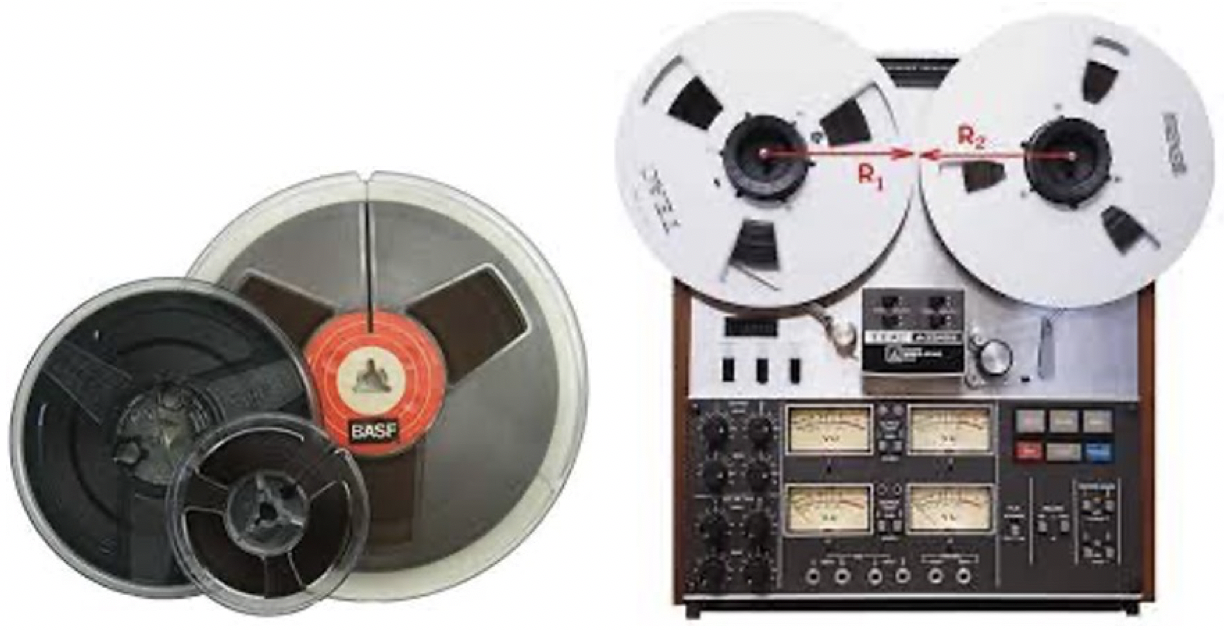
Reel-to-Reel Audio Tape:
The Reel-to-Reel magnetic audio tape recording format first used in the 1920s has remained a part of audio tape recording to this day still used mostly by professionals. To prepare for use, the supply reel containing the tape is placed on a spindle or hub. The end of the tape is manually pulled from the reel, threaded through mechanical guides and over a tape head assembly, and attached by friction to the hub of the second, initially empty take-up reel. For everyday consumers, the Compact Cassette Tape became its successor.
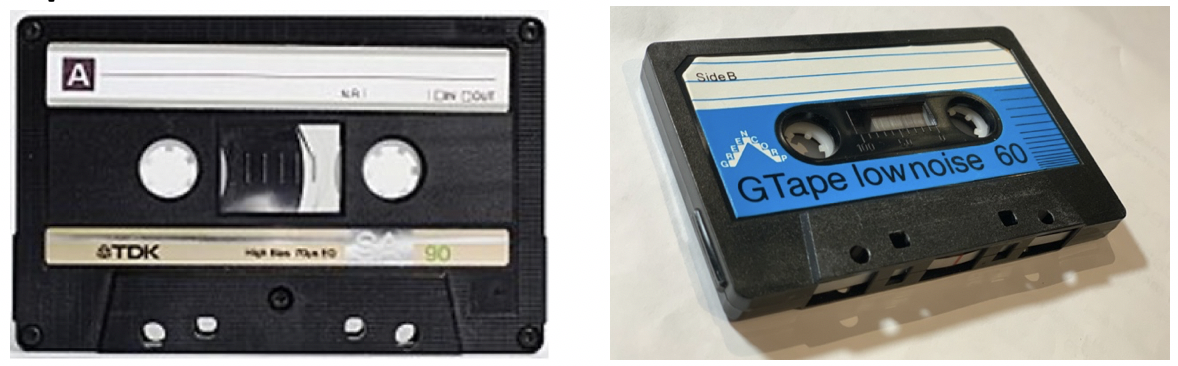
Compact Cassette Audio Tape:
The Compact Cassette, technology introduced in 1963, was originally designed for dictation machines, but improvements in fidelity led the Compact Cassette to supplant the Stereo 8-Track Cartridge and Reel-to-Reel tape recording in most non-professional applications. Its uses ranged from portable audio to home recording to data storage for early microcomputers. The Compact Cassette became one of the two most common formats for pre-recorded music, helped mainly by the creation of the Sony Walkman player, first alongside the LP record and later the Compact Disc (CD).
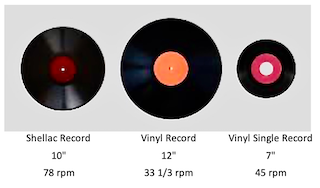
Phonograph Records (Shellac, Vinyl):
Phonograph Records, introduced in the early years of the 20th Century to the modern vinyl LP (from "long playing" or "long play") introduced in 1948 are analogue sound storage mediums characterized by a speed of 78 rpm, 33+1⁄3 rpm or 45 rpm on 10-inch or 12-inch or 7-inch diameter disks. Apart from a few relatively minor refinements and the important later addition of stereophonic sound, the LP remained the standard format for pre-recorded music until its gradual replacement from the 1980s to the early 2000s, first by Compact Cassettes and then by Compact Discs and finally by digital music distribution.